
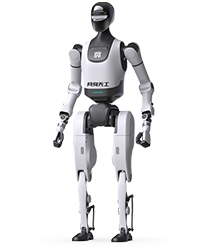
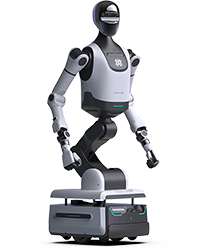
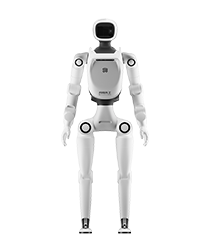


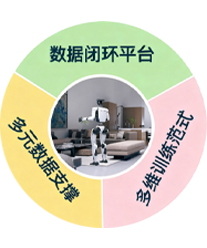

Recently, X- Humanoid (hereinafter referred to as "X- Humanoid") has claimed two consecutive victories in WorldArena, the globally authoritative evaluation—following the WoW embodied world model topping the World Arena Data Engine track, the first "embodied unified" model Pelican-Unify 1.0 once again took the top spot in the World Arena comprehensive evaluation. X- Humanoid has thus become the only company in the world to simultaneously win championships in both of WorldArena’s two core tracks, crowned as the first "double champion" in the embodied intelligence field, with its embodied brain capabilities now among the world’s top tier.
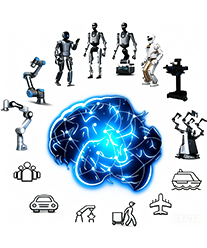
Pelican-Unify 1.0, as an important component of the general-purpose embodied intelligence platform HuiSi KaiWu, simultaneously reaches the world’s top level in dimensions including understanding, reasoning, imagination, and action, with particularly outstanding capabilities in world models, and tops the authoritative World Arena leaderboard. This marks embodied intelligence’s entry from "feature patchwork" into a new stage of "collaborative evolution," laying a solid technical and pathway foundation for advancing toward general-purpose embodied intelligence.
01/Top contenders compete on the same stage, standing out through the most rigorous "touchstone."
WorldArena was jointly initiated by Tsinghua University together with eight leading institutions, including Princeton University, the National University of Singapore, Peking University, the University of Hong Kong, the Chinese Academy of Sciences, Shanghai Jiao Tong University, and the University of Science and Technology of China. It covers six major evaluation dimensions, 16 sub-indicators, and three real-world application tasks. Owing to its academic rigor and industry credibility, it attracted participation from nearly all leading world model teams globally. Amid fierce competition, Pelican-Unify 1.0 stood out with its strong technical capabilities and topped WorldArena.
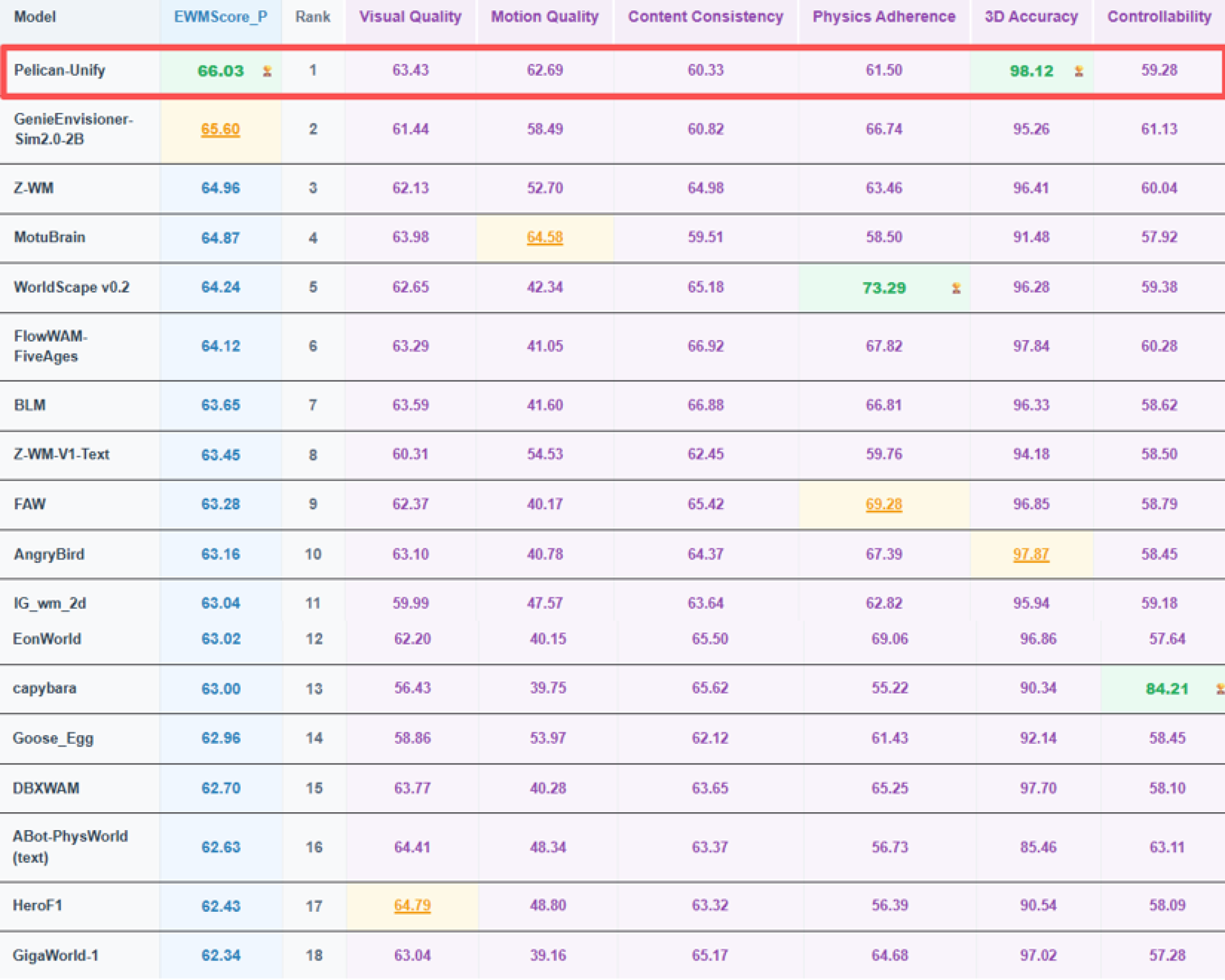
Pelican-Unify 1.0’s rise to the top of the World Arena was not achieved by excelling in just one area; it also demonstrated exceptionally strong overall capabilities. The specific performance is as follows:
EWM Score (composite score) firmly holds the top spot: In an extremely rigorous overall evaluation covering multiple dimensions including visual quality, motion quality, content consistency, physical adherence, and 3D accuracy, Pelican-Unify 1.0 claimed first place overall, with all capabilities perfectly balanced, capable of comprehensively supporting complex long-horizon embodied tasks.
EWM Score (composite score) firmly holds the top spot: In an extremely rigorous overall evaluation covering multiple dimensions including visual quality, motion quality, content consistency, physical adherence, and 3D accuracy, Pelican-Unify 1.0 claimed first place overall, with all capabilities perfectly balanced, capable of comprehensively supporting complex long-horizon embodied tasks.
3D Accuracy near perfect: Embodied intelligence cannot be separated from understanding three-dimensional spatial structure. Through depth estimation error and perspective consistency, Pelican-Unify 1.0’s near-perfect performance fully validates its understanding and construction of spatial geometric relationships in scenes.
3D Accuracy near perfect: Embodied intelligence cannot be separated from understanding three-dimensional spatial structure. Through depth estimation error and perspective consistency, Pelican-Unify 1.0’s near-perfect performance fully validates its understanding and construction of the scene’s spatial geometric relationships.
02/Verified by Authoritative Third-Party Rankings, Embodied Intelligence Ushers in a Breakthrough Moment for a "Unified" Model
In the past, embodied intelligence advanced rapidly along multiple paths: VLM excelled at understanding images and instructions, VLA could map visual-language inputs to actions, and world models could predict future states. But these paths often optimized separately and connected in segments, easily creating fractures between "seeing, thinking, and acting": understanding could not be directly verified by action, action lacked constraints from future consequences, and world imagination was difficult to stably guide through language reasoning.
The core idea of Pelican-Unify 1.0 is that understanding, reasoning, imagination and action should not be four isolated modules, but rather different facets of the same physical intelligence loop, specifically achieving three types of unification:
Unified understanding: mapping scenes, instructions, visual context, and action history into a shared semantic space;
Unified reasoning: transform task intent, action selection, and future consequences into a language-based reasoning process that can be supervised;
Unified generation: jointly generate future video and low-level actions within the same diffusion decoding process, so that actions are shaped by imagined consequences and imagination is constrained by task reasoning.
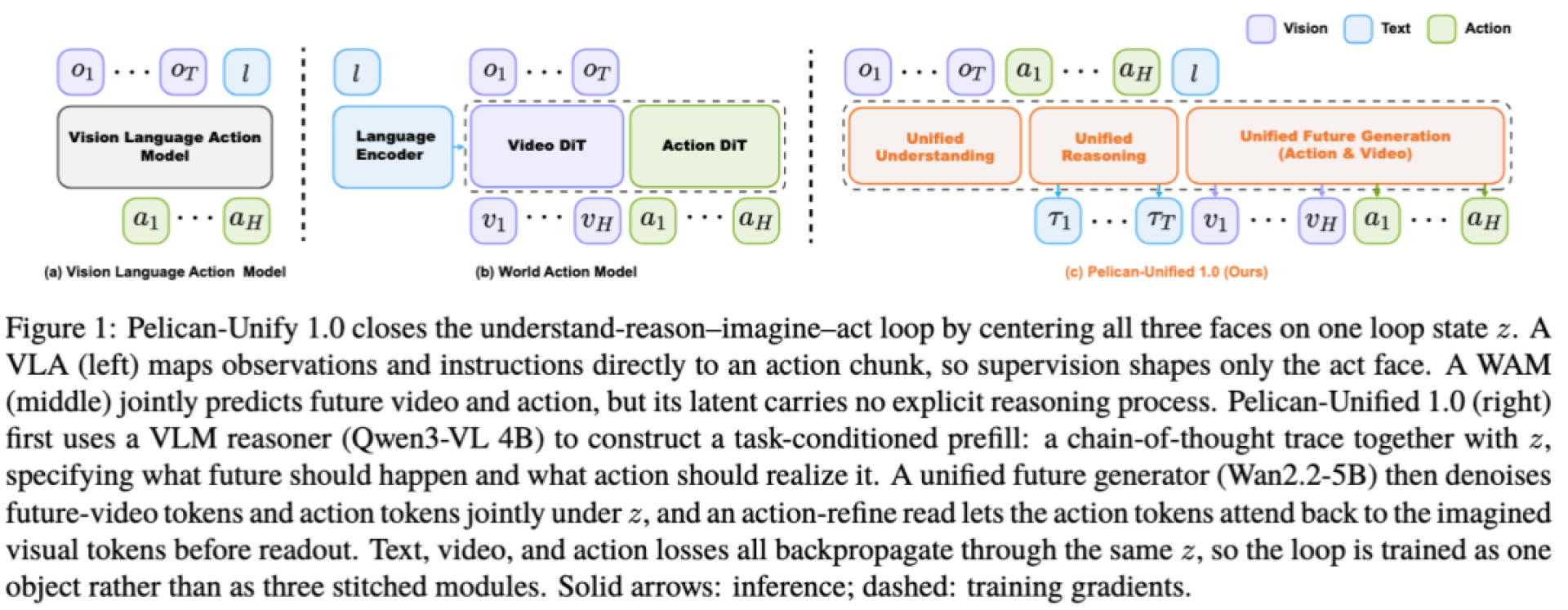
In terms of model architecture, Pelican-Unify 1.0 consists of two tightly coupled parts: the upper layer is a VLM unified understander and reasoner, which builds task states based on scenes, instructions, visual context, and action history, and generates a Chain-of-thought oriented toward tasks, actions, and future consequences; the lower layer is the Unify Future Generator, which, conditioned on the same latent z, jointly generates future videos and action chunks within a unified diffusion process.
Latent z is not a simple module interface, but the key state of the entire physical cognition loop. The three loss streams—text, video, and action—are all backpropagated into the same shared representation, enabling the model to simultaneously learn "how to understand the task," "what will happen next," and "what action should be executed" during training. Therefore, Pelican-Unify 1.0 does not simply chain together a VLM, a world model, and an action policy; rather, it makes them mutually constrain and co-evolve under the same training objective.
03/ Robots "imagine first, then act," with real-machine validation demonstrating the practical value of closed-loop intelligence
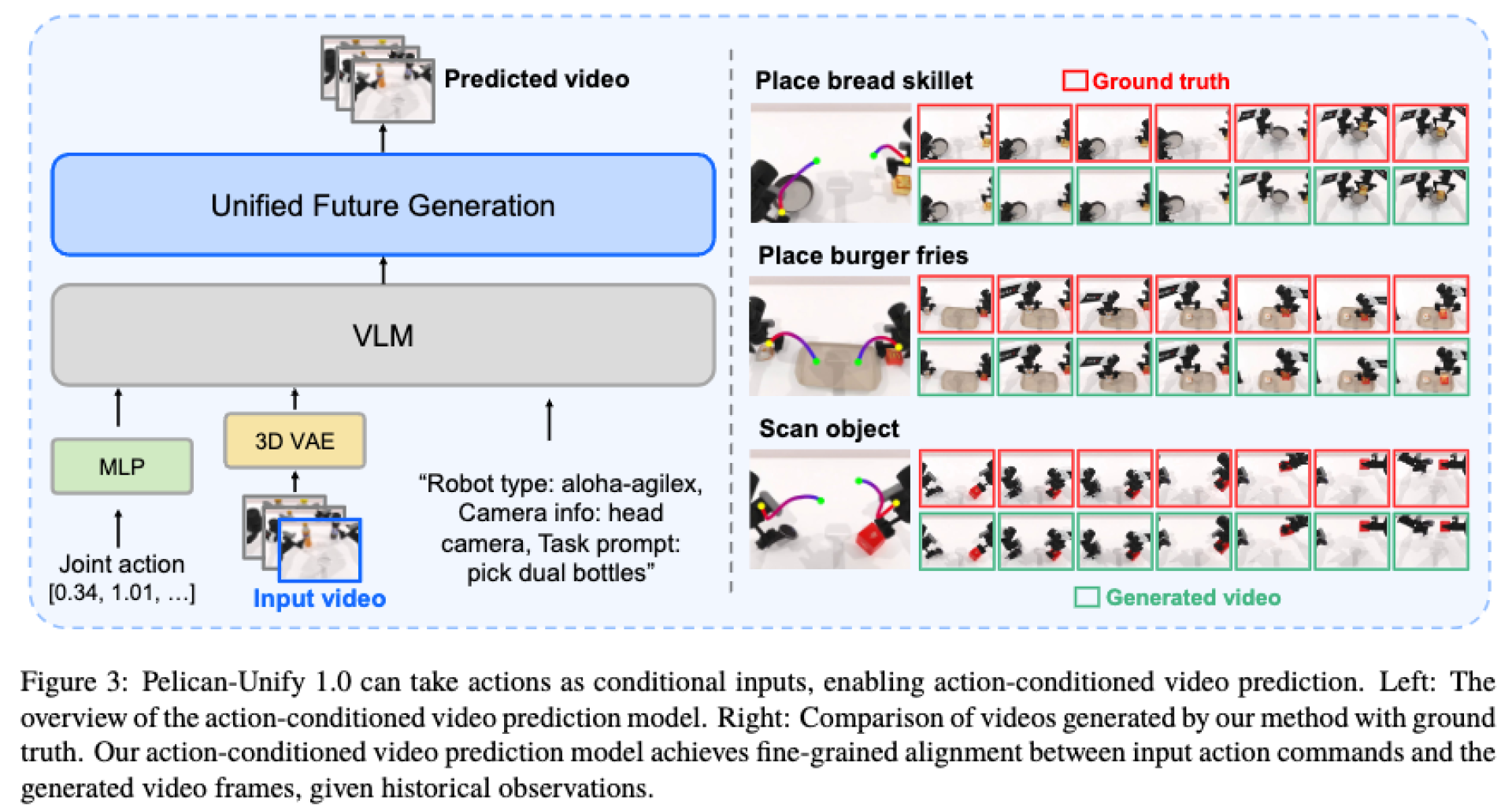
The key capability of Pelican-Unify 1.0 is its ability to generate future visual states before action execution and to align action prediction with future imagination. After receiving historical observations and action conditions, the model can predict the corresponding future video, maintaining fine-grained consistency between action commands and generated frames.
This means that the "imagination" of Pelican-Unify 1.0 is not visual generation detached from execution, but a future rehearsal that serves robot action. Actions are no longer regressed directly from images and language; instead, they are modeled jointly with future states within the same generation process: future frames constrain whether actions are reasonable, and action trajectories also constrain whether the future is reachable. For complex manipulation tasks, this mechanism can help the model better handle long-horizon dependencies, object contact, occlusion, and spatial changes.
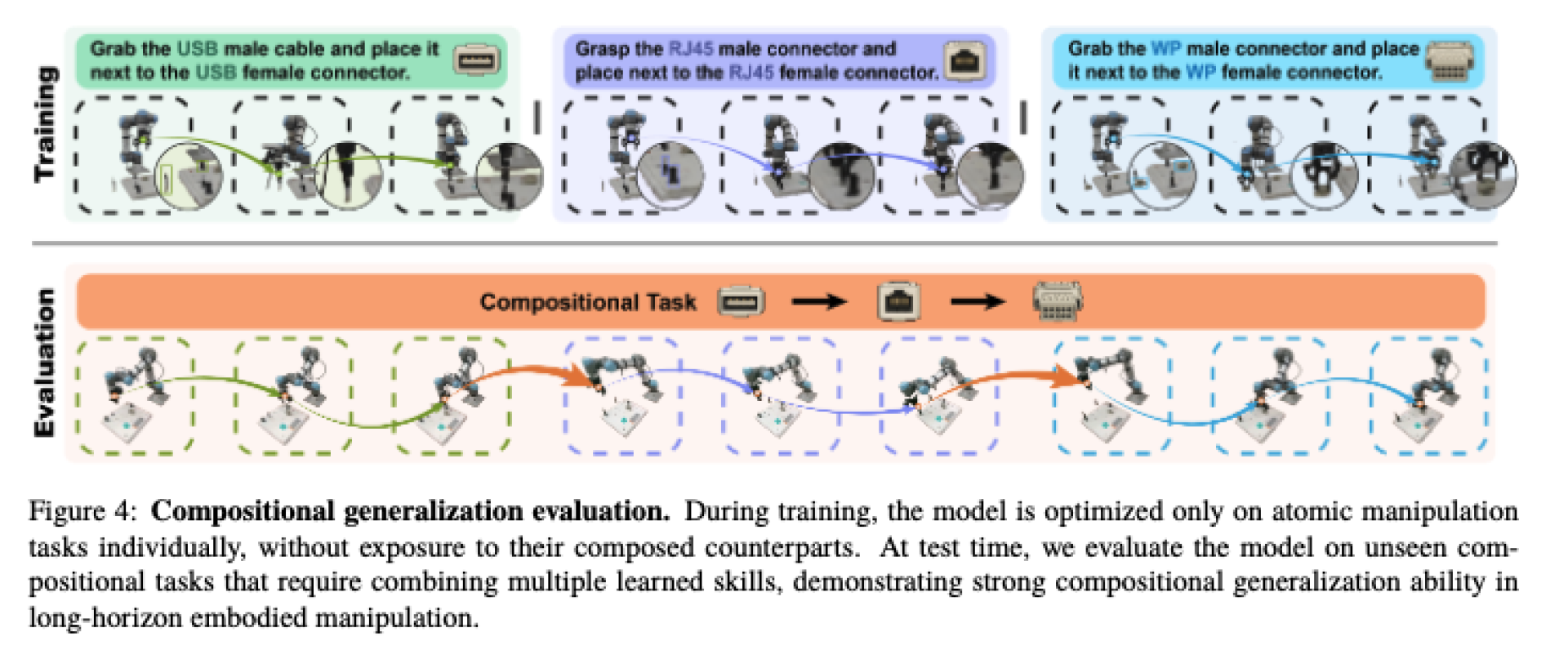
Real robots are the true testing ground for the "reasoning–imagination–action" loop. X- Humanoid deployed Pelican-Unify 1.0 on the TianGong humanoid robot and a UR5e robotic arm, focusing on validating compositional generalization and zero-shot transfer. In the compositional generalization experiment, the model was trained only on atomic task data such as "inserting an RJ45 connector" and "applying waterproofing treatment," without ever seeing a complete combined demonstration. During testing, the robot needed to follow natural language instructions to first plug in the cable and then apply waterproofing, maintaining the task goal across stages and planning the next step based on prior results. Pelican-Unify 1.0 successfully completed this type of previously unseen long-horizon compositional task.
04/ Unification is not a compromise; third-party testing platforms authoritatively verify individual capabilities.
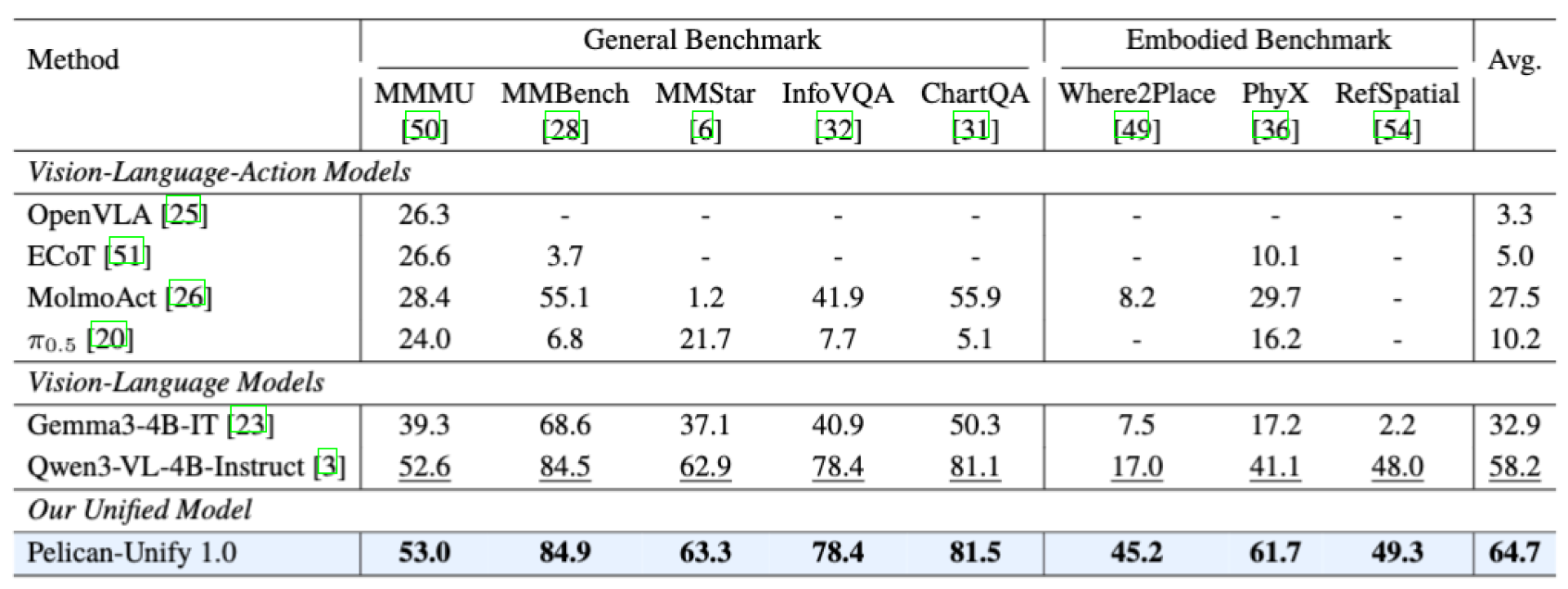
The most easily questioned aspect of a unified model is this: if multiple capabilities are put into one model, will each capability become weaker? The experimental results of Pelican-Unify 1.0 provide the answer.
It ranks first among models of the same level in unified understanding and reasoning capabilities. In VLM evaluations, Pelican-Unify 1.0 achieved an average score of 64.7 across 8 General / Embodied Benchmarks, all reaching SOTA levels, and on the more embodied Where2Place and PhyX, it improved by 28.2 and 20.6 points respectively compared to the base model, proving that unified training does not weaken general multimodal capabilities, but instead enhances spatial understanding, physical understanding, and action-related semantics.
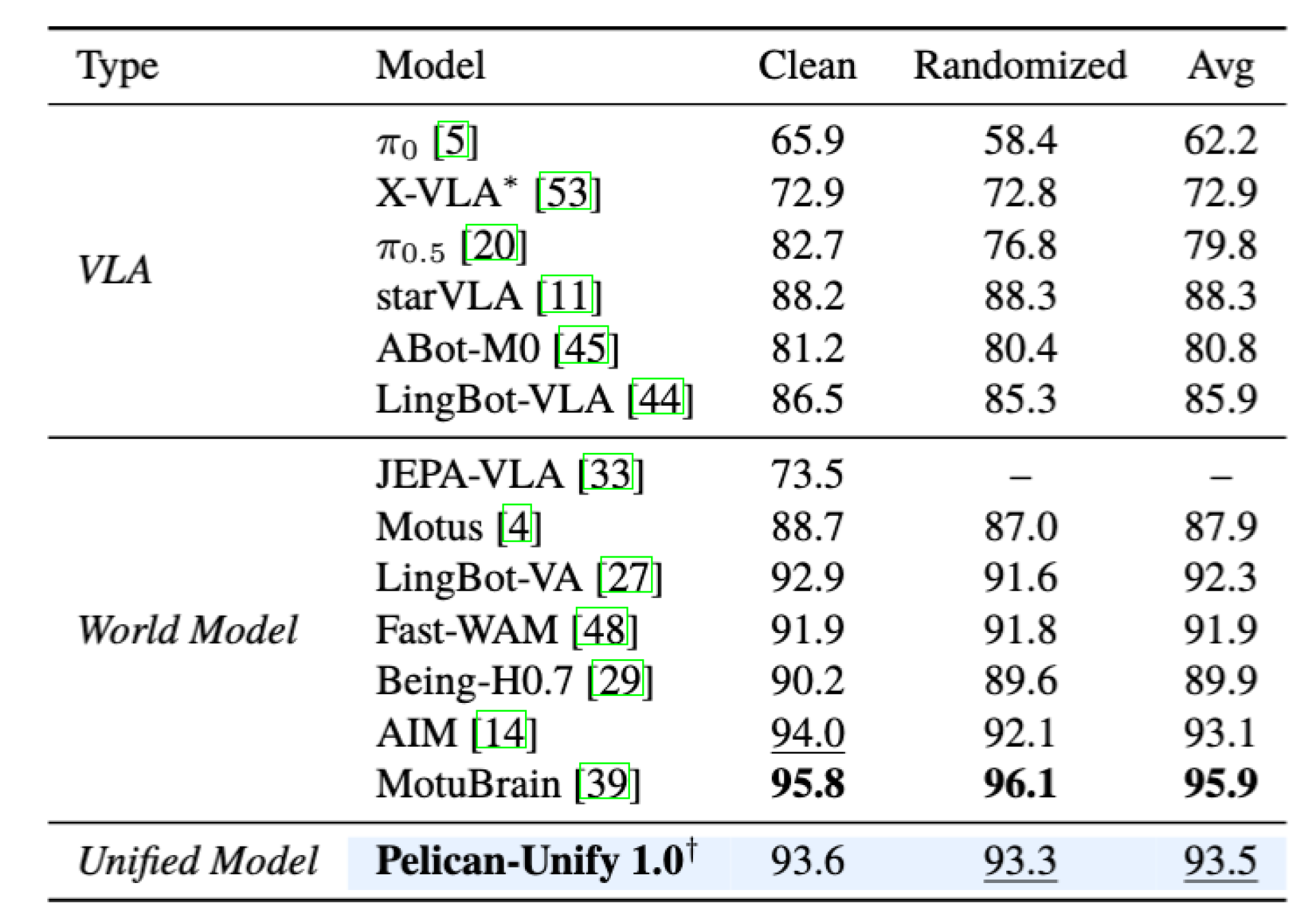
In terms of unified action generation capability, overall performance is comparable to the best models. Pelican-Unify 1.0 achieved a 93.5% average success rate on the RoboTwin 50-task dual-arm benchmark, with 31 of the 50 tasks reaching at least 95% success rate and 15 tasks reaching 100%, covering different types of tasks such as insertion, stacking, and handover. This is basically on par with the performance of current SOTA models, proving that the unified embodied foundation model possesses strong action execution capabilities.
05/ Toward a New Paradigm for General Embodied Intelligence
Pelican-Unify 1.0’s rise to the top means more than just claiming first place on a particular leaderboard; it proposes a modeling path closer to general embodied intelligence: rather than treating understanding, reasoning, imagination, and action as independent modules to be optimized separately and then stitched together through engineering, it enables them from the outset to share representations, train jointly, and shape one another.
The value of this approach lies in enabling the model to retain expert capabilities while forming a more complete closed-loop intelligence in real tasks. The robot can understand goals and scenarios; the reasoning process makes task intent observable; future imagination gives actions a sense of consequence; and action execution in turn tests whether understanding and imagination are reliable. Pelican-Unify 1.0 shows that the next stage of embodied intelligence may not simply be larger vision models, stronger action policies, or more realistic world models, but an adaptive system that unifies "seeing, thinking, imagining, and acting."
The developer of Pelican-Unify 1.0, the X- Humanoid, builds a full-stack closed-loop system covering "body—brain—cerebellum—platform—ecosystem" with its dual core of the general-purpose robot platform "Embodied TianGong" and the general-purpose embodied intelligence platform "HuiSi KaiWu," integrating top-tier models into real production and service scenarios to unleash their true value. The keyword for the next stage of embodied intelligence is forming a more complete closed loop and the coordinated evolution of the capabilities of the brain’s various parts—and with the technical accumulation of a "double champion," X- Humanoid lowers the entry barrier for embodied intelligence and accelerates the evolution of humanoid robots from specialized equipment to general-purpose productivity tools.
Paper address: https://arxiv.org/pdf/2605.15153


 京公网安备11011202100775号